Domain laufzeitsystem.de kaufen?
Wir ziehen mit dem Projekt
laufzeitsystem.de um.
Sind Sie am Kauf der Domain
laufzeitsystem.de interessiert?
domain@kv-gmbh.de · 0541-91531010
Domain laufzeitsystem.de kaufen?
Wann braucht man Present Continuous?
Present Continuous wird verwendet, um über Handlungen zu sprechen, die gerade in diesem Moment stattfinden. Zum Beispiel: "I am writing an email right now." Es wird auch verwendet, um über geplante Handlungen in der nahen Zukunft zu sprechen, wie in: "I am meeting a friend for lunch tomorrow." Darüber hinaus wird Present Continuous verwendet, um über vorübergehende Handlungen zu sprechen, die nicht Teil einer langfristigen Gewohnheit sind, wie in: "She is working on a project this week." Schließlich wird Present Continuous verwendet, um über sich verändernde oder sich entwickelnde Situationen zu sprechen, wie in: "The weather is getting warmer." **
Past simple oder past continuous?
Die Entscheidung zwischen Past Simple und Past Continuous hängt davon ab, ob die Handlung als abgeschlossen oder als in der Vergangenheit fortlaufend dargestellt werden soll. Das Past Simple wird verwendet, um über abgeschlossene Handlungen in der Vergangenheit zu sprechen, während das Past Continuous verwendet wird, um über Handlungen zu sprechen, die zu einem bestimmten Zeitpunkt in der Vergangenheit stattgefunden haben und möglicherweise noch andauerten. **

Ähnliche Suchbegriffe für Continuous Learning
Top-Angebote
Produkte zum Begriff Continuous Learning:
-
Anthony High Performance Continuous Moisture Eye Cream - 15 mlAnthony High Performance Continuous Moisture Eye Cream - 15 ml Anthony High Performance Continuous Moisture Eye Cream is an advanced eye cream developed for the delicate skin around the eyes. The moisturizing formula works specifically to care for the skin, reduce the appearance of puffiness, dark circles, fine lines and wrinkles, and give the eye area a fresher and more well-groomed appearance. The innovative time-release formula is designed to release moisturizing and nourishing ingredients over time, so that the skin around the eyes receives continuous care. The formula is suitable for all skin types and can be used both morning and evening. Intensive moisture and care for the eye area Anthony combines several caring ingredients in this eye cream. Sodium hyaluronate, a form of hyaluronic acid, helps bind moisture in the skin, while shea butter, squalane and jojoba esters contribute to a soft and comfortable skin feel. The formula also contains caffeine, arnica, allantoin, cucumber, carrot root and bisabolol. Caffeine and arnica help give the eye cream its targeted care for a tired and puffy appearance, while the antioxidants vitamins A, C and E help protect and nourish the skin. Peptides, biotin and panthenol are also included in the formulation and support smoother and more well-groomed skin around the eyes. Fresher and more awake appearance The eye area is one of the places where signs of fatigue and aging often become visible first. High Performance Continuous Moisture Eye Cream is developed to provide the area with intensive moisture while reducing the appearance of fine lines, dark circles and puffiness. The lightweight eye cream is easy to integrate into your daily skincare routine and can also be used around the mouth to reduce the appearance of smile lines. How to use Apply 1-2 pumps to the index or ring finger. Gently pat the product around the eye area - both under the eyes and along the brow bone. Avoid rubbing the skin. Use morning and evening on cleansed skin. The product can also be used around the mouth as needed.46,96 €*Versand: 5,99 €Sichere Weiterleitung zum Anbieter
-
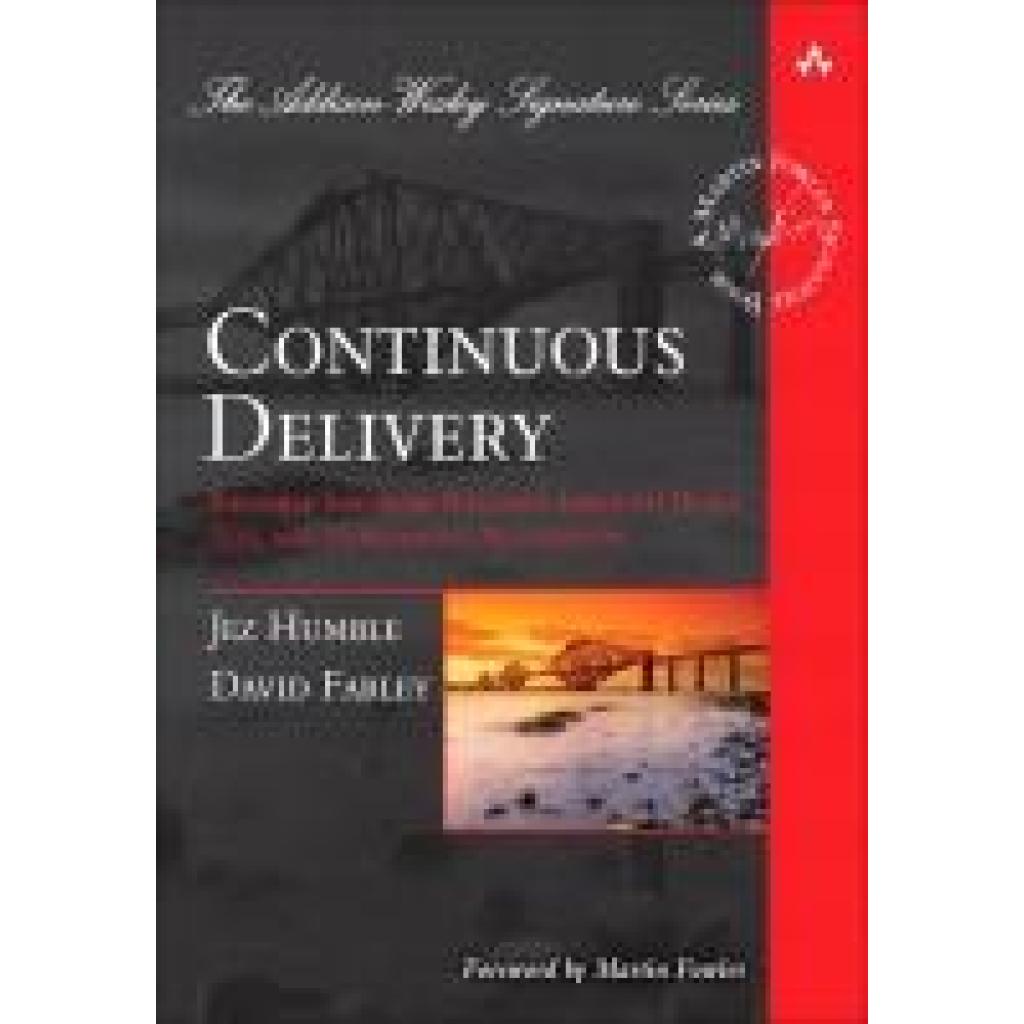
Humble, Jez: Continuous Delivery: Reliable Software Releases through Build, Test, and Deployment AutomationContinuous Delivery: Reliable Software Releases through Build, Test, and Deployment Automation , Winner of the 2011 Jolt Excellence Award ! Getting software released to users is often a painful, risky, and time-consuming process.This groundbreaking new book sets out the principles and technical practices that enable rapid, incremental delivery of high quality, valuable new functionality to users. Through automation of the build, deployment, and testing process, and improved collaboration between developers, testers, and operations, delivery teams can get changes released in a matter of hours-sometimes even minutes-no matter what the size of a project or the complexity of its code base. Jez Humble and David Farley begin by presenting the foundations of a rapid, reliable, low-risk delivery process. Next, they introduce the "deployment pipeline," an automated process for managing all changes, from check-in to release. Finally, they discuss the "ecosystem" needed to support continuous delivery, from infrastructure, data and configuration management to governance. The authors introduce state-of-the-art techniques, including automated infrastructure management and data migration, and the use of virtualization. For each, they review key issues, identify best practices, and demonstrate how to mitigate risks. Coverage includes Automating all facets of building, integrating, testing, and deploying software Implementing deployment pipelines at team and organizational levels Improving collaboration between developers, testers, and operations Developing features incrementally on large and distributed teams Implementing an effective configuration management strategy Automating acceptance testing, from analysis to implementation Testing capacity and other non-functional requirements Implementing continuous deployment and zero-downtime releases Managing infrastructure, data, components and dependencies Navigating risk management, compliance, and auditing Whether you're a developer, systems administrator, tester, or manager, this book will help your organization move from idea to release faster than ever-so you can deliver value to your business rapidly and reliably. , Federungsset > Sportfederung , Auflage: 1. Auflage, Erscheinungsjahr: 201007, Produktform: Leinen, Autoren: Humble, Jez~Farley, David, Auflage: 10001, Auflage/Ausgabe: 1. Auflage, Seitenzahl/Blattzahl: 512, Abbildungen: Illustrations, Themenüberschrift: COMPUTERS / Programming / General~COMPUTERS / Software Development & Engineering / General, Fachschema: Computers - Languages / Programming, Fachkategorie: Programmier- und Skriptsprachen, allgemein, Imprint-Titels: Pearson Professional, Warengruppe: HC/Programmiersprachen, Fachkategorie: Software Engineering, Thema: Verstehen, Text Sprache: eng, UNSPSC: 49019900, Warenverzeichnis für die Außenhandelsstatistik: 49019900, Verlag: Addison Wesley, Verlag: Addison Wesley, Verlag: Pearson Education Limited, Länge: 237, Breite: 186, Höhe: 31, Gewicht: 1035, Produktform: Gebunden, Genre: Importe, Genre: Importe, Katalog: LIB_ENBOOK, Katalog: Gesamtkatalog, Katalog: Internationale Lagertitel, Katalog: internationale Titel, Katalog: Kennzeichnung von Titeln mit einer Relevanz > 30, Katalog: Lagerartikel, Book on Demand, ausgew. Medienartikel, Relevanz: 0014, Tendenz: +1, Unterkatalog: AK, Unterkatalog: Bücher, Unterkatalog: Hardcover, Unterkatalog: Lagerartikel, WolkenId: 16292549,05 €*Versand: 0,00 €Sichere Weiterleitung zum Anbieter
-
Springer Enabling Horizontal Collaboration Through Continuous Relational Learning (Englisch, Softcover, Alejandra Isabel Cuevas, Eduardo Ubaghs, Maria Jesus Saenz) (55556382)Springer Enabling Horizontal Collaboration Through Continuous Relational Learning (Englisch, Softcover, Alejandra Isabel Cuevas, Eduardo Ubaghs, Maria Jesus Saenz) (55556382)53,49 €*Versand: 0,00 €Sichere Weiterleitung zum Anbieter



-
Simple past oder past continuous?
Die Entscheidung zwischen Simple Past und Past Continuous hängt davon ab, ob die Handlung als abgeschlossen oder als in der Vergangenheit fortlaufend dargestellt werden soll. Simple Past wird verwendet, um über abgeschlossene Handlungen zu sprechen, während Past Continuous verwendet wird, um über Handlungen zu sprechen, die zu einem bestimmten Zeitpunkt in der Vergangenheit stattfanden und möglicherweise noch im Gange waren. **
-
Wann wird das Past Continuous verwendet?
Das Past Continuous wird verwendet, um über eine Handlung oder einen Zustand zu sprechen, der zu einem bestimmten Zeitpunkt in der Vergangenheit im Gange war. Es wird oft verwendet, um den Hintergrund für eine andere Handlung oder Ereignis zu beschreiben, das ebenfalls in der Vergangenheit stattfand. Das Past Continuous wird auch verwendet, um eine längere Handlung oder eine wiederholte Handlung in der Vergangenheit zu beschreiben. Es wird normalerweise mit Signalwörtern wie "while", "when", "as" oder "at that time" verwendet. Insgesamt wird das Past Continuous verwendet, um eine fortlaufende Handlung oder Situation in der Vergangenheit zu betonen. **
-
Wann benutzt man die Continuous Form?
Die Continuous Form wird verwendet, um auszudrücken, dass eine Handlung zu einem bestimmten Zeitpunkt in der Vergangenheit, Gegenwart oder Zukunft im Verlauf war oder noch andauert. Sie wird oft verwendet, um eine Handlung zu betonen, die gerade im Moment des Sprechens stattfindet. Die Continuous Form wird auch verwendet, um eine temporäre Handlung oder eine Handlung mit begrenzter Dauer zu beschreiben. Darüber hinaus wird sie verwendet, um eine Handlung zu beschreiben, die bereits geplant oder vereinbart wurde. **
-
Wann braucht man das Past Continuous?
Das Past Continuous wird verwendet, um über eine Handlung oder einen Zustand zu sprechen, der zu einem bestimmten Zeitpunkt in der Vergangenheit im Gange war. Es wird oft verwendet, um eine längere Handlung zu beschreiben, die unterbrochen wurde oder um den Kontext für eine andere Handlung in der Vergangenheit zu schaffen. Zum Beispiel: "I was studying when my friend called me." Es wird auch verwendet, um zwei Handlungen zu vergleichen, die gleichzeitig in der Vergangenheit stattfanden. Zum Beispiel: "She was cooking dinner while he was watching TV." Insgesamt wird das Past Continuous verwendet, um eine fortlaufende Handlung oder einen Zustand in der Vergangenheit zu betonen. **

Wann wird das present continuous verwendet?
Das Present Continuous wird verwendet, um über Handlungen zu sprechen, die gerade in diesem Moment passieren. Es wird auch verwendet, um über Handlungen zu sprechen, die in der Zukunft geplant oder vereinbart sind. Darüber hinaus wird das Present Continuous verwendet, um über vorübergehende Handlungen zu sprechen, die nicht Teil einer Routine sind. Es wird auch verwendet, um über sich ändernde Situationen oder Trends zu sprechen. **
Wann wird das Past Continuous benötigt?
Das Past Continuous wird verwendet, um über eine Handlung oder einen Zustand zu sprechen, die zu einem bestimmten Zeitpunkt in der Vergangenheit im Gange waren. Es wird oft benutzt, um Hintergrundinformationen zu beschreiben oder um zwei Handlungen zu vergleichen, die gleichzeitig stattfanden. Außerdem wird das Past Continuous verwendet, um eine Handlung zu betonen, die unterbrochen wurde. Es wird oft mit dem Simple Past kombiniert, um eine längere Handlung zu beschreiben, die plötzlich unterbrochen wurde. **
Top-Angebote
Produkte zum Begriff Continuous Learning:
-
Anthony High Performance Continuous Moisture Eye Cream - 15 mlAnthony High Performance Continuous Moisture Eye Cream - 15 ml Anthony High Performance Continuous Moisture Eye Cream is an advanced eye cream developed for the delicate skin around the eyes. The moisturizing formula works specifically to care for the skin, reduce the appearance of puffiness, dark circles, fine lines and wrinkles, and give the eye area a fresher and more well-groomed appearance. The innovative time-release formula is designed to release moisturizing and nourishing ingredients over time, so that the skin around the eyes receives continuous care. The formula is suitable for all skin types and can be used both morning and evening. Intensive moisture and care for the eye area Anthony combines several caring ingredients in this eye cream. Sodium hyaluronate, a form of hyaluronic acid, helps bind moisture in the skin, while shea butter, squalane and jojoba esters contribute to a soft and comfortable skin feel. The formula also contains caffeine, arnica, allantoin, cucumber, carrot root and bisabolol. Caffeine and arnica help give the eye cream its targeted care for a tired and puffy appearance, while the antioxidants vitamins A, C and E help protect and nourish the skin. Peptides, biotin and panthenol are also included in the formulation and support smoother and more well-groomed skin around the eyes. Fresher and more awake appearance The eye area is one of the places where signs of fatigue and aging often become visible first. High Performance Continuous Moisture Eye Cream is developed to provide the area with intensive moisture while reducing the appearance of fine lines, dark circles and puffiness. The lightweight eye cream is easy to integrate into your daily skincare routine and can also be used around the mouth to reduce the appearance of smile lines. How to use Apply 1-2 pumps to the index or ring finger. Gently pat the product around the eye area - both under the eyes and along the brow bone. Avoid rubbing the skin. Use morning and evening on cleansed skin. The product can also be used around the mouth as needed.46,96 €*Versand: 5,99 €Sichere Weiterleitung zum Anbieter
-
Humble, Jez: Continuous Delivery: Reliable Software Releases through Build, Test, and Deployment AutomationContinuous Delivery: Reliable Software Releases through Build, Test, and Deployment Automation , Winner of the 2011 Jolt Excellence Award ! Getting software released to users is often a painful, risky, and time-consuming process.This groundbreaking new book sets out the principles and technical practices that enable rapid, incremental delivery of high quality, valuable new functionality to users. Through automation of the build, deployment, and testing process, and improved collaboration between developers, testers, and operations, delivery teams can get changes released in a matter of hours-sometimes even minutes-no matter what the size of a project or the complexity of its code base. Jez Humble and David Farley begin by presenting the foundations of a rapid, reliable, low-risk delivery process. Next, they introduce the "deployment pipeline," an automated process for managing all changes, from check-in to release. Finally, they discuss the "ecosystem" needed to support continuous delivery, from infrastructure, data and configuration management to governance. The authors introduce state-of-the-art techniques, including automated infrastructure management and data migration, and the use of virtualization. For each, they review key issues, identify best practices, and demonstrate how to mitigate risks. Coverage includes Automating all facets of building, integrating, testing, and deploying software Implementing deployment pipelines at team and organizational levels Improving collaboration between developers, testers, and operations Developing features incrementally on large and distributed teams Implementing an effective configuration management strategy Automating acceptance testing, from analysis to implementation Testing capacity and other non-functional requirements Implementing continuous deployment and zero-downtime releases Managing infrastructure, data, components and dependencies Navigating risk management, compliance, and auditing Whether you're a developer, systems administrator, tester, or manager, this book will help your organization move from idea to release faster than ever-so you can deliver value to your business rapidly and reliably. , Federungsset > Sportfederung , Auflage: 1. Auflage, Erscheinungsjahr: 201007, Produktform: Leinen, Autoren: Humble, Jez~Farley, David, Auflage: 10001, Auflage/Ausgabe: 1. Auflage, Seitenzahl/Blattzahl: 512, Abbildungen: Illustrations, Themenüberschrift: COMPUTERS / Programming / General~COMPUTERS / Software Development & Engineering / General, Fachschema: Computers - Languages / Programming, Fachkategorie: Programmier- und Skriptsprachen, allgemein, Imprint-Titels: Pearson Professional, Warengruppe: HC/Programmiersprachen, Fachkategorie: Software Engineering, Thema: Verstehen, Text Sprache: eng, UNSPSC: 49019900, Warenverzeichnis für die Außenhandelsstatistik: 49019900, Verlag: Addison Wesley, Verlag: Addison Wesley, Verlag: Pearson Education Limited, Länge: 237, Breite: 186, Höhe: 31, Gewicht: 1035, Produktform: Gebunden, Genre: Importe, Genre: Importe, Katalog: LIB_ENBOOK, Katalog: Gesamtkatalog, Katalog: Internationale Lagertitel, Katalog: internationale Titel, Katalog: Kennzeichnung von Titeln mit einer Relevanz > 30, Katalog: Lagerartikel, Book on Demand, ausgew. Medienartikel, Relevanz: 0014, Tendenz: +1, Unterkatalog: AK, Unterkatalog: Bücher, Unterkatalog: Hardcover, Unterkatalog: Lagerartikel, WolkenId: 16292549,05 €*Versand: 0,00 €Sichere Weiterleitung zum Anbieter
-
Wann braucht man Present Continuous?
Present Continuous wird verwendet, um über Handlungen zu sprechen, die gerade in diesem Moment stattfinden. Zum Beispiel: "I am writing an email right now." Es wird auch verwendet, um über geplante Handlungen in der nahen Zukunft zu sprechen, wie in: "I am meeting a friend for lunch tomorrow." Darüber hinaus wird Present Continuous verwendet, um über vorübergehende Handlungen zu sprechen, die nicht Teil einer langfristigen Gewohnheit sind, wie in: "She is working on a project this week." Schließlich wird Present Continuous verwendet, um über sich verändernde oder sich entwickelnde Situationen zu sprechen, wie in: "The weather is getting warmer." **
-
Past simple oder past continuous?
Die Entscheidung zwischen Past Simple und Past Continuous hängt davon ab, ob die Handlung als abgeschlossen oder als in der Vergangenheit fortlaufend dargestellt werden soll. Das Past Simple wird verwendet, um über abgeschlossene Handlungen in der Vergangenheit zu sprechen, während das Past Continuous verwendet wird, um über Handlungen zu sprechen, die zu einem bestimmten Zeitpunkt in der Vergangenheit stattgefunden haben und möglicherweise noch andauerten. **
-
Simple past oder past continuous?
Die Entscheidung zwischen Simple Past und Past Continuous hängt davon ab, ob die Handlung als abgeschlossen oder als in der Vergangenheit fortlaufend dargestellt werden soll. Simple Past wird verwendet, um über abgeschlossene Handlungen zu sprechen, während Past Continuous verwendet wird, um über Handlungen zu sprechen, die zu einem bestimmten Zeitpunkt in der Vergangenheit stattfanden und möglicherweise noch im Gange waren. **
-
Wann wird das Past Continuous verwendet?
Das Past Continuous wird verwendet, um über eine Handlung oder einen Zustand zu sprechen, der zu einem bestimmten Zeitpunkt in der Vergangenheit im Gange war. Es wird oft verwendet, um den Hintergrund für eine andere Handlung oder Ereignis zu beschreiben, das ebenfalls in der Vergangenheit stattfand. Das Past Continuous wird auch verwendet, um eine längere Handlung oder eine wiederholte Handlung in der Vergangenheit zu beschreiben. Es wird normalerweise mit Signalwörtern wie "while", "when", "as" oder "at that time" verwendet. Insgesamt wird das Past Continuous verwendet, um eine fortlaufende Handlung oder Situation in der Vergangenheit zu betonen. **
Ähnliche Suchbegriffe für Continuous Learning
-
Springer Enabling Horizontal Collaboration Through Continuous Relational Learning (Englisch, Softcover, Alejandra Isabel Cuevas, Eduardo Ubaghs, Maria Jesus Saenz) (55556382)Springer Enabling Horizontal Collaboration Through Continuous Relational Learning (Englisch, Softcover, Alejandra Isabel Cuevas, Eduardo Ubaghs, Maria Jesus Saenz) (55556382)53,49 €*Versand: 0,00 €Sichere Weiterleitung zum Anbieter
-
Wann benutzt man die Continuous Form?
Die Continuous Form wird verwendet, um auszudrücken, dass eine Handlung zu einem bestimmten Zeitpunkt in der Vergangenheit, Gegenwart oder Zukunft im Verlauf war oder noch andauert. Sie wird oft verwendet, um eine Handlung zu betonen, die gerade im Moment des Sprechens stattfindet. Die Continuous Form wird auch verwendet, um eine temporäre Handlung oder eine Handlung mit begrenzter Dauer zu beschreiben. Darüber hinaus wird sie verwendet, um eine Handlung zu beschreiben, die bereits geplant oder vereinbart wurde. **
-
Wann braucht man das Past Continuous?
Das Past Continuous wird verwendet, um über eine Handlung oder einen Zustand zu sprechen, der zu einem bestimmten Zeitpunkt in der Vergangenheit im Gange war. Es wird oft verwendet, um eine längere Handlung zu beschreiben, die unterbrochen wurde oder um den Kontext für eine andere Handlung in der Vergangenheit zu schaffen. Zum Beispiel: "I was studying when my friend called me." Es wird auch verwendet, um zwei Handlungen zu vergleichen, die gleichzeitig in der Vergangenheit stattfanden. Zum Beispiel: "She was cooking dinner while he was watching TV." Insgesamt wird das Past Continuous verwendet, um eine fortlaufende Handlung oder einen Zustand in der Vergangenheit zu betonen. **
-
Wann wird das present continuous verwendet?
Das Present Continuous wird verwendet, um über Handlungen zu sprechen, die gerade in diesem Moment passieren. Es wird auch verwendet, um über Handlungen zu sprechen, die in der Zukunft geplant oder vereinbart sind. Darüber hinaus wird das Present Continuous verwendet, um über vorübergehende Handlungen zu sprechen, die nicht Teil einer Routine sind. Es wird auch verwendet, um über sich ändernde Situationen oder Trends zu sprechen. **
-
Wann wird das Past Continuous benötigt?
Das Past Continuous wird verwendet, um über eine Handlung oder einen Zustand zu sprechen, die zu einem bestimmten Zeitpunkt in der Vergangenheit im Gange waren. Es wird oft benutzt, um Hintergrundinformationen zu beschreiben oder um zwei Handlungen zu vergleichen, die gleichzeitig stattfanden. Außerdem wird das Past Continuous verwendet, um eine Handlung zu betonen, die unterbrochen wurde. Es wird oft mit dem Simple Past kombiniert, um eine längere Handlung zu beschreiben, die plötzlich unterbrochen wurde. **
* Alle Preise verstehen sich inklusive der gesetzlichen Mehrwertsteuer und ggf. zuzüglich Versandkosten. Die Angebotsinformationen basieren auf den Angaben des jeweiligen Shops und werden über automatisierte Prozesse aktualisiert. Eine Aktualisierung in Echtzeit findet nicht statt, so dass es im Einzelfall zu Abweichungen kommen kann. ** Hinweis: Teile dieses Inhalts wurden von KI erstellt.